
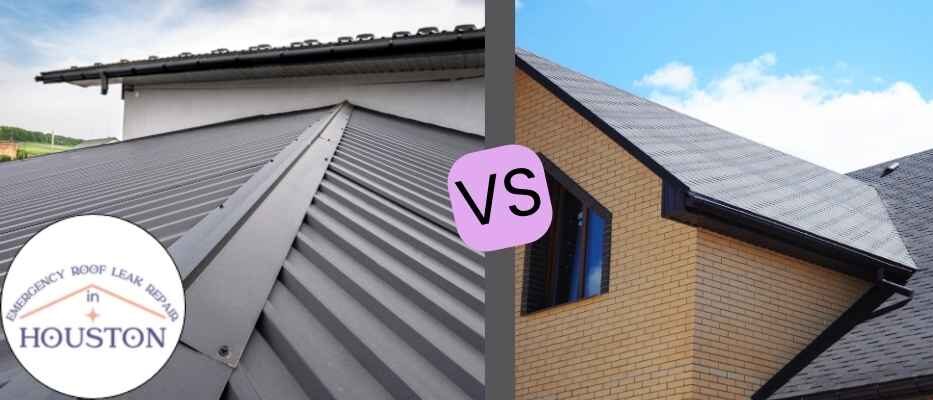
Choosing the right roof isn’t just about looks—it’s one of the biggest financial and functional decisions you’ll make for your home. From upfront costs to long-term durability, the choice between steel (metal) roofing and traditional asphalt shingles can dramatically impact your budget, comfort, and even your property’s value. With so many options available—standing seam panels, corrugated sheets, architectural shingles, and more—it’s easy to feel overwhelmed.
This in-depth guide breaks it all down in a clear, practical way. You’ll discover how installation costs compare across different types of steel roofs and asphalt shingles, including both materials and labor. We’ll explore how pricing can vary depending on location, and take a closer look at lifespan, maintenance requirements, and warranty differences.
Beyond the basics, this guide dives into the bigger picture—energy efficiency, potential insurance savings, and how each roofing choice can influence resale value. You’ll also get insights into common installation mistakes to avoid, along with a lifecycle cost analysis to help you understand the true cost over time.
To make your decision even easier, we’ve included helpful tables, comparisons, and a 10-point checklist so you can confidently choose the roofing option that fits your home, climate, and budget best.
Current Installed Costs: Steel vs Shingles
Steel Roofing Costs
Steel roofing costs are generally higher up front but vary widely by type and quality. Standing seam steel roofs, a popular high-end option, run about $9–$16 per sq.ft. installed (that’s roughly $900–$1,600 per 100 sq.ft. “square”). Corrugated (sheet) steel roofs are on the lower end at about $5–$12 per sq.ft. installed ($500–$1,200 per square). (Galvanized or Galvalume-coated steel typically falls in the $5–$13 per sq.ft. range.) Premium steel panels (like thicker gauges or specialty coatings) approach the upper end of those ranges. For example, a new standing seam roof on a 1,500 sq.ft. home might cost $13,500–$24,000 in total installed cost.
In terms of material alone, steel panels run roughly $1.50–$4 per sq.ft. depending on coating. For instance, Galvanized steel panels might be $1.50–$3.50/sq.ft. (material only), and Galvalume steel (aluminum-zinc alloy) about $2.00–$4.00/sq.ft.. (Painted, coated versions cost more than bare metal.) Labor for metal is significant: expect $4–$8 per sq.ft. for installation, since it requires precision work and safety gear.
Asphalt Shingle Costs
Asphalt shingles cost much less up front. A basic 3-tab asphalt roof runs roughly $3–$5 per sq.ft. installed (about $300–$500 per square). Mid-range architectural shingles (the thicker, 30-year style) cost around $4–$6 per sq.ft. installed (roughly $400–$600/sq). Premium laminated or designer shingles can reach $6–$15 per sq.ft. installed depending on quality and style. For a typical 1,500 sq.ft. roof, asphalt shingles might total $4,500–$9,000 installed. In contrast, a comparably sized metal roof could easily be $15,000–$40,000 depending on type.
Table: Cost & Lifespan Comparison
| Roof Type | Installed Cost (per square ft) | Installed Cost (per 100 sq.ft.) | Typical Lifespan | Warranty (Paint/Material) |
| Corrugated Steel | $5 – $12 | $500 – $1,200 | ~40–60 years | ~30–50+ year finish |
| Standing Seam Steel | $9 – $16 | $900 – $1,600 | ~50–80 years | ~30–50+ year finish |
| 3-Tab Shingles | $3 – $5 | $300 – $500 | ~15–20 years | ~25–30 year limited (prorated) |
| Architectural Shingles | $4 – $6 | $400 – $600 | ~20–30 years | ~30–50 year limited (prorated) |
| Premium/Luxury Asphalt | $6 – $15 | $600 – $1,500+ | ~30+ years | ~30–50+ years (limited) |
(All costs include materials + labor, national averages. Warranties vary by manufacturer.)
Note that prices can fluctuate with market conditions (e.g. steel tariffs, oil prices for asphalt), and contractors’ overhead. But as a rule of thumb: shingles are typically 1/2 to 1/3 the upfront cost of metal.
Labor vs Materials Breakdown
In any roofing project, about half the price is materials and half labor – but the split differs by roofing type. For asphalt shingles, materials (bundles of shingles, underlayment, flashing) might cost on the order of $80–$250 per square, while labor runs roughly $200–$300 per square. In other words, installing a 100 sq.ft. (1 square) asphalt roof might see $300–$500 material and $200–$300 labor. For example, a HomeGuide breakdown shows a 3-tab asphalt square costs $300–$500 installed, implying about $200–$400 in materials plus $100–$200 labor (roughly).
Metal roofing has a higher labor component because the installation is more involved. HomeGuide notes metal roof labor is $4–$8 per sq.ft. (meaning $400–$800 per square). Material costs (metal panels, underlayment) can be $100–$500 per square depending on metal type. In practice, I often see about 50–60% of a metal roof quote going to labor. As one contractor observed, metal installations can be 3× slower than shingle roofs – a key reason asphalt crews can roof multiple houses in the time it takes to do one metal roof. (In my own work, a 2,000 sq.ft. asphalt roof might take 1–2 days with a crew, whereas a metal job of similar size can take 4–5 days including prep and safety setup.) Table below illustrates typical labor vs materials:
Table: Labor vs. Material Cost (per 100 sq.ft.)
| Roof Type | Materials (per square) | Labor (per square) | Notes |
| Corrugated Steel | $100 – $500 | $400 – $800 | Simple panels, but exposed fasteners require sealants. |
| Standing Seam Steel | $300 – $900 | $600 – $1,600 | Hidden fasteners; labor intensive seams. |
| Asphalt Shingles (3-tab) | $80 – $130 | $200 – $300 | Many crews available, quick install. |
| Asphalt Shingles (Arch.) | $100 – $250 | $200 – $300 | Heavier shingles slightly slower, but still quick. |
(Figures are national averages. Actual quotes depend on roof size, pitch, complexity.)
Regional Cost Variation
Roofing costs vary by region due to local labor rates and material availability. Coastal states and metro areas tend to have higher labor charges. For example, roofing contractors in California or Northeast might charge 10–20% more than the national average, whereas costs can be lower in parts of the Midwest or South. Building codes (snow load requirements, hurricane-proofing) also affect prices. In this article we quote national average ranges; any individual quote could be higher or lower. Always get multiple bids and factor in local conditions.
Lifespan, Maintenance & Warranties
One of the biggest differences between steel and shingles is longevity. A quality steel roof can last 40–70+ years (many metal roofs on early 1900s homes are still doing fine today). In contrast, standard asphalt shingles last about 15–30 years before needing full replacement (though premium asphalt can edge toward 30). In practical terms, a homeowner may replace an asphalt roof 2–3 times over the lifespan of one new metal roof.
Maintenance needs follow lifespan: metal roofs require minimal upkeep. They resist warping, algae, and have few failure points beyond checking clips or sealant lines. In my experience, I recommend inspecting a metal roof every 5–10 years and re-tightening screws or re-caulking seams if needed. Asphalt roofs need more attention: damaged shingles must be replaced, flashing checked, and moss or debris cleaned off regularly. Typical complaints on shingle roofs are cracked or curled shingles after extreme heat or wind, and loss of granules over time.
Warranty coverage also differs. Steel roof panels often carry paint/coating warranties of 30–50 years (for example, Kynar-500 PVDF-coated steel commonly has a 30-year warranty, and recent industry improvements now offer up to 50-year finish warranties on Galvalume panels). Some manufacturers even offer 40–60 year warranties on coated steel. These warranties cover fading and cracking of the finish, not accidental damage. Workmanship warranties (from the installer) vary by contractor, but reputable metal roofers often guarantee labor for 10–20 years.
Asphalt shingle warranties are usually 20–50 years (limited), but these are prorated and often contingent on proper installation. A common lifetime warranty on shingles might be 50 years, but only 10–20 years of that are non-prorated, after which you pay a percentage of repair cost. For example, a GAF Timberline Lifetime shingle has a 50-year full-coverage period. Workmanship warranties on shingles (from roofers) are typically 5–10 years, and shingle manufacturers often require installation by a certified contractor to honor the best terms.
| Aspect | Steel Roof (e.g. Standing Seam) | Asphalt Shingles (Architectural) |
| Expected Lifespan | ~50–70 years (many last 80+) | ~20–30 years (premium shingle ~30) |
| Paint/Finish Warranty | 30–50 years (e.g. Kynar coatings) | N/A (shingles have mineral surface; fade warranty ~25 yrs on algae) |
| Material Warranty | Rarely bare-steel warranty (finish only); very long life | 25–50 year limited (prorated after ~10 yrs) |
| Workmanship Warranty | 10–20+ years (varies by installer) | 5–10+ years (common) |
| Maintenance Required | Low – wash debris, re-seal fittings occasionally | Moderate – replace broken shingles, clean algae/debris |
Energy Savings and Insurance Benefits
A major hidden perk of metal roofs is energy efficiency. Metal panels reflect sunlight and heat, keeping your attic cooler in summer. Industry sources estimate 7–20% savings on annual cooling costs with a metal roof compared to dark shingles. (One study of certain “cool roof” metal systems saw ~30–50% better efficiency vs. shingles.) In practice, I’ve seen customers with metal roofs report noticeably cooler attics and modestly lower electric bills in summer. Shingles, by contrast, absorb heat like a black sponge, which can bump up air-conditioning use.
On insurance, steel can lower premiums. Because metal resists hail, wind, fire and falls under “impact-resistant” building codes, many insurers reward homeowners. The Metal Roofing Alliance notes good metal roofs can cut your homeowner’s insurance by 5–35% depending on location. In hail-prone regions, savings may even reach 20–30%. Homeowners often fail to realize this benefit. In my state, I routinely advise clients to check for a “class 4 impact-resistant” discount. (Some states mandate discounts on Class 4 roofs by law.) Shingle roofs generally don’t earn these discounts; in fact, they might not improve your rates at all and can even raise premiums in fire or wind zones.
Resale Value and ROI
When it comes to home value, metal roofs shine. Real estate studies show roof replacements recoup about 60–70% of their cost on sale. But a metal roof often recoups ~85–90%. In other words, buyers recognize the premium roof as a long-term asset. For example, a Zillow analysis cited by experts indicates a metal roof returns ~85.9% of the investment at resale, versus ~60–70% for a typical asphalt roof. In practical terms: if you spend $20,000 on a metal roof, you might see an $17,000 increase in home value (pending market). If you spend $10,000 on shingles, you might only get $6,000–$7,000 added value.
From personal experience, homes with metal roofs often get a boost in curb appeal and sell faster, especially in upscale neighborhoods. Even if you’re not selling soon, the improved resale value is like an insurance policy on your investment.
Common Installation Challenges (Roofer’s Perspective)
Installing steel vs. shingles involves different challenges. Steel Roof Considerations: As one of my contractor colleagues quipped, “metal is best… but it’s not as profitable” because of labor. Metal roofs require precise cuts, concealed fasteners, and often working at a higher pitch. Corners, ridges and penetrations must be sealed carefully to prevent leaks. In cold weather, metal expands and contracts, so installers must allow proper movement at clips. Safety is also trickier – standing seam roofs are slippery. Noise can be an issue; rain on an uninsulated metal roof can sound loud inside, so proper insulation or foam is advised. In my jobs, I always double-check that panels are correctly aligned – one misaligned panel can ruin the appearance. The upside: with hidden fasteners, there are fewer exposed nails to leak, and the finish is integral, so shingle blow-offs are not a concern.
Asphalt Shingle Considerations: Shingles are more “forgiving” to install; many crews are experts at them. They can be snapped or nailed up quickly. However, shingle roofs come with their own pitfalls. Underlayment must be installed correctly; a failure (like letting ice dams form) leads to leaks. Flashing is critical: improper valleys or step flashing around chimneys can cause water intrusion. High winds can rip off shingles if not nailed per spec. Granule loss on lower-quality shingles can leave the roof bare. In my roofing calls, I often quote fixes for wind or sun-damaged shingles. Many roofers (including myself) worry more about a poorly-installed asphalt roof: a few missing shingles can turn into leaks after a storm.
In summary, metal requires a skilled crew and attention to detail (but can be done in any season), whereas shingles allow faster installation but need vigilance about weather-related damage. Anecdotally, one contractor noted he could install three shingle roofs in the time it took to do one metal roof – something to consider if project timeline matters.
Lifecycle Cost Comparison
Let’s look at the long-term (60-year) cost. Assume an asphalt shingle roof costs $10k and lasts 20 years, while a steel roof costs $20k and lasts 60 years. In that time, the asphalt roof would need three complete replacements ($30k total), whereas the steel roof is replaced only once at $20k (or in reality, often not replaced at all if it truly lasts 60 years).
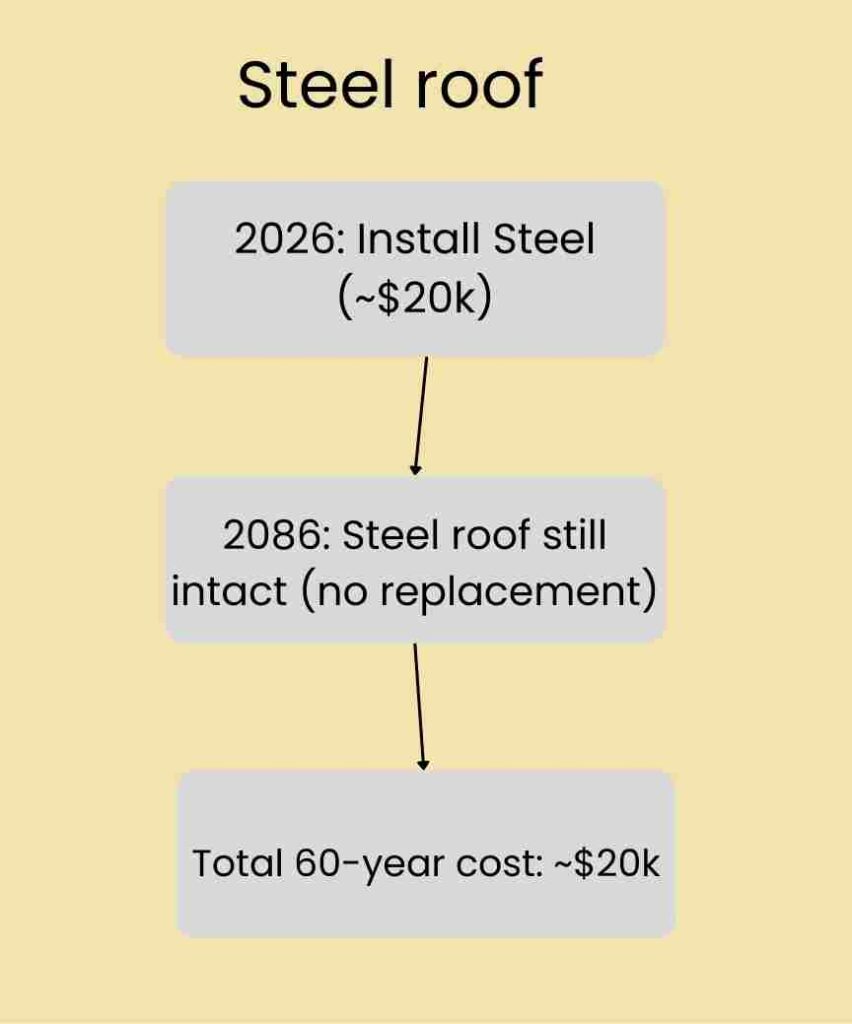
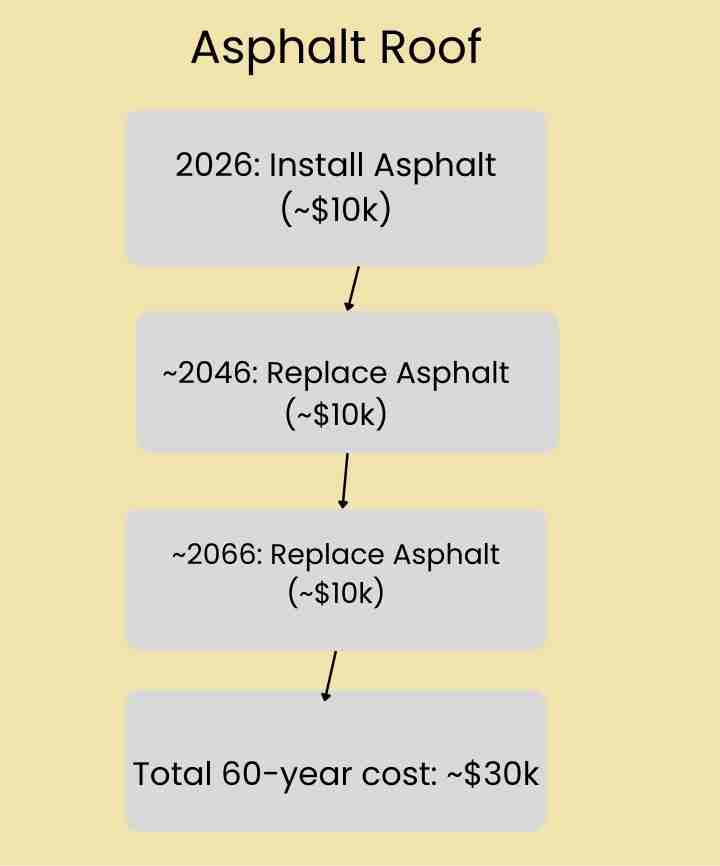
In practice, metal roofs often save money over a lifetime. For instance, Advanced Roofing’s analysis shows if metal initial cost is double asphalt (20k vs 10k), the total expense over 60 years favors metal, since asphalt needed three replacements. We also factor in maintenance: asphalt likely incurs extra spot repairs (say $1k per cycle for minor fixes) that metal largely avoids. When you spread it out, the annualized cost can be lower for metal. For example, $20k over 60 years is about $333 per year, whereas $30k (asphalt total) over 60 years is $500 per year.
Other factors tilt long-term cost: energy savings (~20% off cooling bills) and insurance credits (5–30% off premium) further offset metal’s upfront investment. HomeAdvisor reports that metal may “save $15K+ over 30 years” thanks to longevity and energy efficiency. All told, even if a metal roof starts out ~2× the price of shingles, over the roof’s life it often costs less to own.
Pros & Cons (Side-by-Side)
| Steel Roof | Asphalt Shingles | |
| Pros: | Lasts a very long time (40–70+ years) Saves energy by reflecting heat Strong and can handle wind, hail, and fire Needs very little maintenance and is eco-friendly | Here’s the easy, simple version: Cheap to install at the beginning Quick and easy to put on Many styles and colors available Can resist fire well |
| Cons: | Here’s the easy, simple version: Expensive at the beginning (2–3 times more than shingles) Takes more time and skill to install Can be noisy during rain or hail | Here’s the easy, simple version: Doesn’t last as long (around 20–30 years) Needs more care and repairs over time Holds heat, so your house can get hotter Can get damaged easily by strong wind or hail |
(Sources: roofing industry data and contractor insights.)
This comparison shows why I often pitch metal roofs to buyers planning to stay in their home for decades, and asphalt to those needing a tight budget or short-term fix.
10-Point Decision Checklist for Homeowners
- Budget vs. Lifespan: Do you need the lowest upfront cost (asphalt) or lowest long-term cost (steel)? If budget is tight, shingles win initially. If staying long-term, metal pays off.
- Home’s Expected Life: Planning to sell or move in 5–10 years? Asphalt may suffice. Staying 20+ years? Metal’s longevity may justify extra cost.
- Climate and Weather: In a hot, sunny climate or areas prone to hail/wind, metal’s reflectivity and durability are big pluses. If you live in a mild, shaded area, shingles could be okay.
- Energy Efficiency Needs: If reducing cooling bills is important, metal can cut AC costs by ~10–20%. Shingles offer no such savings (and even generate attic heat).
- Insurance Premiums: Check with your insurer – metal roofs often qualify for 5–35% premium discounts. Shingles rarely get discounts.
- Architectural Style: Do you want the look of cedar, slate, or metal? High-end shingles or stone-coated steel can both look nice, but metal offers more color choices and a different aesthetic.
- Structural Load: Metal is lightweight (especially aluminum); heavy shingles add more dead load. Ensure your roof framing is adequate. Most homes handle either, but it’s a check.
- Installation Timeframe: If you need a fast replacement, installers often finish a shingle roof in days, whereas metal might take longer due to complexity (see Contractor’s Perspective).
- Maintenance Tolerance: Are you okay inspecting the roof every few years? Metal needs very little maintenance. Shingles require occasional spot fixes. Decide how proactive you want to be.
- Warranty and Quality: Compare specific product warranties. Steel often carries longer paint warranties. Read the fine print on both material and labor guarantees. Ensure your roofer is certified for whichever type you pick.
Using this checklist will help you balance the upfront costs, life-cycle costs, and practical factors to make the right choice for your home.
Final thought
In my experience, steel roofs cost more up front but can be worth it if you’re aiming for the roof to “be the last one you ever buy.” They offer long life, low maintenance, energy savings, and often better insurance rates. Asphalt shingles, on the other hand, are budget-friendly and quick to install, but they’ll likely need replacing every couple of decades and demand more upkeep.
If you can afford it and plan to stay, I usually lean towards steel – “buy once, cry once,” as some say. But if cash flow is tight or you might move before the roof ages, quality asphalt shingles are still a good, proven choice. Whichever you choose, work with a reputable contractor who can show past work and has proper licenses. Ask for detailed quotes that separate labor and materials. And remember to consider those hidden benefits (energy, insurance, resale) that metal brings.
Ultimately, the best roof is one that fits your budget, home, and goals. I hope this guide – with real costs, timelines, and boots-on-the-roof insights – helps you make an informed decision. Feel free to reach out to local experts for personalized quotes, and good luck on your roofing project!